Showing posts with label chaos. Show all posts

Sunday, 22 April 2012

Topaz filters and a little tree therapy

thicket © Caroline Fraser 2012
I have had a busy week, and have restored my equilibrium over the weekend with two long walks in the woods with dog.

I took a proper camera and a monopod; a compromise over the need to carry a tripod for decent depth of field, and my need to walk and feel unburdened by my equipment. As always I carry just one lens, and see what I can do with it. This weekend I have rediscovered the fun of a wide angle lens. My Sigma 10-20 mm has not been out for a while, but for my current project on chaos in the woods it is perfect, allowing a wider depth of focus than most of my other lenses, and better  quality images than a standard telephoto lens.

I have downloaded Topaz B&W effects for a one month trial, and am experimenting to see if it is something I would like to buy. I already have Lightroom which has a number of monochrome options, but am struggling to use the programme efficiently. Topaz can be used from within Photoshop, and is therefore simpler to use.


So what have I found?


I am wary of producing images that look overcooked. So many journalistic photographers seem to use Topaz filters for portraits, and the overall effect is to over accentuate the pores and wrinkles to a point where they look unatural. Likewise landscapes can have too much 'venetian' effect or 'pop', and the effect immediately destroys the image in my eye.


I like to use black and white layers within photoshop to enhance the contrast in an image without creating an obvious filter effect. I copy the background layer and convert the layer to monochrome. The blending mode is then changed to soft light or overlay and the percentage opacity altered according to taste.


black and white overlay on a colour image using soft light as the blending mode


Here is the first image unadulterated


and here with the Topaz diffusion filter applied as  a layer with some additional blur


with diffusion and blur

and here with no blur


with diffusion and no blur


Some images work better in black and white, especially for conveying nature's chaos.


original image


with high contrast monochrome effect and vignetting


original
colour image with  monochrome overlay in soft light blending mode


same image using Topaz BW  infra red effect, exaggerated grain and vignetting
One could play around for hours and  probably create all of these effects without Topaz, but the ability to preview many different effects, and then to fine tune the effect is attractive. 


grunge


aged effect


You just need to be careful not to overcook the albumen or go overboard on the 'grunge'. 

Sunday, 12 February 2012

back to chaos and expressing feelings

"I had a very cold walk and enjoyed the ice crystals" © caroline fraser 2012


sometimes a photo just represents a good time......


is an expression of mood,


and how a sunny blue sky and a very cold morning can make one feel.


there is no hidden meaning


at all


ice crystals


 stream


nature's chaos


cold


Wednesday, 8 June 2011

Insomnia ....................... a poem for my classmates


Insomnia


It's over

I can relax

I should be fast asleep


But lying here

at 3am


my mind spins on, relentlessly,


wondering how it will fill


the whole uncharted day that is


tomorrow.


Not wanting to be immersed in the domestic bliss

that is a clean and tidy desk,

a spotless fridge.


Last night a programme on botanical classification


"bringing order to the chaos that is nature"


Those words,
my words,
others' words.


They won't go away.


I want to be a photographer

thinking, creating, curating.


Fractals and chaos


Order and classification


My mind won't stop


I'm clinging on


wanting,


waiting,


fearful of stagnating.


What will tomorrow bring?


Monday, 23 May 2011

When is the best time to do research for a photography project and the art of hanging an exhibition

Forest © Caroline Fraser 

Getting near the end now; just had a talk on how to hang a show; I thought I knew a fair amount about that, but then I wasn't planning to suspend a TV from the ceiling or create a rigging to suspend my precious art works from the ceiling. After a 90 minute lecture from the technical manager of the School of Art, interrupted regularly by the sound of his frog croak mobile phone ring-tone, I am now au-fait with the likes of spring toggles, SDS drills, strap hangers and the joys of high quality tools.

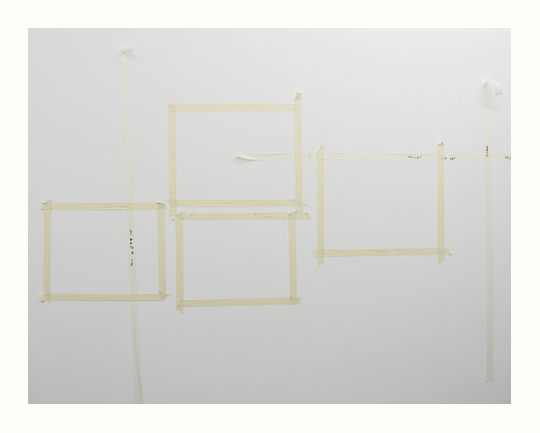
As I am showing three regular framed prints fixed with mirror plates (which, after this morning's talk, I now know should be placed 10% above the half way point of the frame's vertical ), most of this was more information than needed, but at least I know where to go if I do ever branch into more exotic hangings. The most useful tip was to mark your drill holes and spacing onto masking tape, so as not to leave pencil markings on the wall.

Two weeks before all the work has to be handed in I finally have time to reflect on what I have been doing for the last 9 months. The traumas of trying to settle on my project meant that for some weeks I have been unable to concentrate on reading anything related to my subject topic. I am now emerging into the light at the end of the tunnel and have found I can read again. This is a little late in my view; or is it?

One of the things that research does is inform the work that you are doing; I have been unable to inform my work as until quite recently I was not clear about my purpose. I believe my project to be about searching for beauty amongst the chaos and order of nature, both at Hawkwood; a relatively wild spot in suburbia, and on the streets around my home.

Looking on the library database I find very few books that contain both "suburbia" and "vegetation / garden " or "photography" as key words. One I have already enjoyed is "Suburbia" by Bill Owen written in the 1970's. This is primarily about the people who move into a new suburb and how they individualise their personal spaces. It focusses on the people and their home interiors, thoughts and beliefs. It does not, however look much at the outdoor vegetation, except a cursory look at the importance of a well-tended lawn.

The only other titles that came up on my search are " How Britain got the gardening bug" a BBC4 2009 DVD which I have not yet managed to see, and "Paradise Now" by Peter Bialobrzeski  , a book published in 2009 with what I consider to be stunningly beautiful images of Asian metropolises filmed mainly at twilight. Peter was born in 1961 in Wolfsburg. link to his website ( in german)

Paradise Now #13, C-Print, Größe 60 x 75 und 126 x 160 cm
Paradise Now #13, 2009 , Peter Bialobrzeski

These images were created on a 4x5 Linhoff large format camera, some with exposures of up to 8 minutes. The long exposures mean that people disappear from the captured image. Bialobrzeski quotes Walker Evans at the opening of his book " I am interested what any time present will look like as the past". My original concept that started me on my project was a desire to capture something of my life for those left behind when I am gone; I thought they might be interested in how my home looked, or what I had for dinner. I soon found that I was unable to enjoy these subject matters. What I have created is my personal view of the area where I live. Devoid of people, but with human presence acutely evident in the neatly trimmed hedges and pollarded trees, I have, in essence shown how 2011 suburbia might look like as the past. Like Bialowbrzeski I have shown the urban dwellings as a back-drop to the vegetation. His images are described in the commentary as "very beautiful" by Alex Ruhle. He seems drawn to the chaotic element of the vegetation in the same way that I am drawn to nature's chaos in most of my photography.

But behind this beauty he has a point to make; he is concerned with the environmental impact of all the bright lighting that is used in these urban spaces, and how much longer this can be justified. When the time comes for sensible restraint in the use of urban lighting and energy supplies, then comes the time when his images become "the past". He comments that "decadence and stupidity almost always look quite pretty", and that " the pictures will become historical as the responsibility requires us  to resort to technologies that put a halt to this waste".


Paradise Now Nr. 18, page 45, C-Print, Größe 60 x 75 und 126 x 160 cm
Paradise Now #18 by Peter Bialobrzeski
 These words get me reflecting on what underlies my "Springtime in Suburbia", and what message will be conveyed. Will viewers understand my preference for chaos over order, and does it matter if they don't? What will the images say to people in the future? Do they give a fair comment on my locality or am I giving a false view of reality. Walking past the subject of my "magnolia" image today on a dull morning, when the blossoms have faded and there are now leaves instead of flowers, I realise that the view I have created was only there for a moment. I had to stop and think how I had achieved the perspective that I used. I created a momentary reality and that is so often what photography is all about. If suburbia were suddenly devoid of human habitation for any reason, the trees and plants would rapidly regain control and break into the chaos that is their natural tendency.

Since most photography is about a moment captured, we can never hope to truly to convey what is "now" for those who chance upon it in the future. What we are doing is giving our own very perspective on the world around us, and that leaves me quite content, even if I don't have a deeper message to convey.

As for when is the right time to do research,  sometimes it might be before you start on a project in order to find a starting point, and sometimes, as in my discovering Bialobrzeski , it is near the end, when you start to reflect on what it all means. Having seen his work, I now want to try some shots with movement in, to contrast with the very static, formal images I have been collecting...........


Sunday, 24 April 2011

On Beauty


chrysanthemum


I have said that I would like to write about beauty; but what is it?


Picasso said .....................

"Beauty?... To me it is a word without sense because I do not know where its meaning comes from nor where it leads to."


This seems very sensible, since much of what we see as beautiful has been ingrained in us by the media and our cultural background. Fatness and thinness are beautiful or not depending on where in the world you live. Our choices of furniture and decor are a mirror on the society that we live in. The aesthetic movement was known for creating a lifestyle, affecting not just how we create art, but also what furniture, wall coverings and china were used.

Another view is that beauty is useless;

"Remember that the most beautiful things in the world are the most useless; peacocks and lilies for instance." ~John Ruskin, The Stones of Venice, 1851


After seeing the aesthetic movement displayed at the V&A, I have seen a surfeit of peacocks, particularly as part of ornate friezes hand painted above the picture rail in the homes of wealthy members of the movement.


I am not sure that I agree with Ruskin that beautiful things are in general  useless. If they give us pleasure then is that not enough?

Alain de Botton, in his book "How Proust can change your life",  talks about the gap between our own lives and the realm of beauty, or between what we imagine and what really exists. He describes the importance of images in our appreciation of our surroundings, and the risks of leaving home with the wrong ones. This idea rings true with me having visited Key West in Florida last year.

In my mind was an image of  leafy green coves and beautiful white sandy beaches on small islands. I think I had something like the Caribbean in mind. How wrong I was, and therefore how disappointed I felt when I arrived and found a very large town with narrow rocky beaches. I felt the same emotions that Proust's narrator felt when he arrived at Balbec in Normandy, and found it to be far from the rugged cliff-top, gothic coastline of his imagination. He arrived in a typical early twentieth century beach resort, busy and commercial, rather like Key West, and felt let down.

The following quote resonates ,

"Though we travel the world over to find the beautiful, we must carry it with us or we find it not". ~Ralph Waldo Emerson

Proust's narrator was taken in hand and shown how to take pleasure from the boats on the water and the clothes of the other tourists in bright colours.

In other words, beauty is everywhere, we just have to find it, and that depends on our frame of mind. I find beauty in nature, which may be because of the frame of mind that natural places allow me.


"daydreams" by Caroline Fraser

To be deep in a wood,  high on a mountain, or alone on a beach is an uplifting experience; does that make it a beautiful place? John Muir certainly thought so....., and having hiked the John Muir trail into Yosemite I understand his sentiments...............

"Everybody needs beauty as well as bread, places to play in and pray in, where nature may heal and give strength to body and soul."

 So as DeBotton describes, beauty is something to be found, as in the active appreciation of new situations.
It is "incapable of answering the expectations of an over romantic imagination".

This course has confirmed to me that I find my beauty in nature. Not for me a designer handbag or a pair of Jimmy Choo shoes. Whilst contemplating this fact I  rememember  my favourite book on photography "Bortom Redan" or "Beyond Order". I am lucky enough to have copy of this book, which is now out of print, signed by the author. On the first page is a quote that confirms my view on beauty by James Gleick.


" The essence of the earth's beauty lies in disorder, a peculiarly patterned disorder, from the fierce tumult of rushing water to the tangled filigrees of unbridled vegetation".


Gleick collaborated with Eliot Porter on a book called "Nature's chaos", writing an essay about chaos theory in nature to accompany Porter's photographs. I have ordered a copy , as I feel that it may be relevant to my photography. He clearly had an influence on Jan Tove, who writes of the order and disorder of nature in his book. He describes the strucure of a tree and the nature of fractal geometry........

A fern is a classic example of a fractal in nature, as is a snowflake or a globe artichoke.


ferns in Allerce forest, Chile 

tree fern, Hollyford track, New Zealand

Jan Tove says

"the tree branches out from the trunk in all directions, down to the smallest shoot where the veins of the leaves repeat the broken pattern. The characteristic properties of the fractal are that it repeats itself in the same way as when two mirrors are angled towards each other. A chain of images occur. When studying a fractal we look into the borderland between chaos and order".

He appears to have been influenced by Gleick, as I have been influenced by Tove.

I prefer the disorderly order of nature to the enforced order of suburbia, and that is probably why I escape to forests and mountains whenever I get the chance.