Showing posts with label symmetry. Show all posts

Saturday, 3 May 2014

Countdown to my departure from Gore. Thoughts on a small town in Southland, New Zealand.

another busy day in Gore - Broughton Street


Only 5 days left before I leave Gore and I am getting sentimental about the impending departure.

The image above is of Broughton Street on a Friday mid morning. Hill fog clinging over the town on an autumn day.

There is no litter in this town.

And no dog poo anywhere to be seen. New Zealand is not a great place to be a dog unless you live on a farm. Dogs are rarely allowed off the lead, and there are many places where they are not allowed in order to protect the birds, penguins and other wildlife.

As I walked down the hill a random stranger in her seventies or eighties stopped and offered me a lift into town. I thanked her, and politely declined, for I was out to walk the streets for almost the last time.


a plot of land in Gore

As I strolled I came across a plot of land for sale. I am sure Janine would be pleased if I bought it, but it has no view of the hills, so is a non starter.

I came across a big hedge; one of my favourite subjects for street photography, thinking about the psychology of personal space and boundaries.

Hedges are massive in the countryside here, mainly to act as windbreaks.

the pylon problem; typical farm hedge


But the purpose of this in the middle of town was less clear.


Privacy Please


This one (above) seems a little over the top. A secret garden perhaps?


And these ones (below) appear purely decorative.


Symmetry rules


neat and tidy

A modern home demands a modern garden. I certainly prefer these free flowing native flaxes to the tightly clipped box hedges.


Flax plants ( otherwise known as Phormium)

I am not sure about the colour of this home (below), but you can see their wood pile. Everyone seems to be chopping or stacking or collecting trailer-loads of wood this weekend, ready for the winter. No smokeless zone here.


I prefer orange for my house if it has to be a bright colour. No clipped hedges here.

My kind of garden. Loose and free.

orange

Corrugated metal roofs are almost universal. Some with matching fence. This one will look best on 25th December.


waiting for Christmas


But the best thing about this place is that if you drive for 3 minutes in any direction you are out of town, on a country road, heading nowhere very particular at all.


Unless you are visiting a farmer.


And there are plenty of them around here.


I don't think I was meant to live where I do………  (the depths of suburbia)


I see changes afoot.


Saturday, 25 June 2011

Collography, collodion and dechirage.................at the East Sussex Contemporary Art fair

The last few days have been immensely busy; a graduate show at Central St Martins , followed 24 hours later by the East Sussex Contemporary Art show; two very different experiences, in which the biggest lesson learnt has to be that people like free stuff, and that very few people outside the photographic community understand what a "C-type" print or an "archival digital print" are.

Much of my work is abstract, and not instantly recognisable as a photograph, so I tried to give details that would make this clear; but maybe not clear enough. My work "Daydreams 2" (below) has attracted the most attention on my stand at the art show, and although derived from a photo of reflections in a stream, is sufficiently far removed from the original subject after manipulation to confuse the viewer into believing that what they see is not a photograph. much of my recent photographic work has involved layering and collage, and this is an example of the use of symmetry in the layering process.


Daydreams 2    (copyright Caroline Fraser 2011)

 Understanding other artists techniques is always a challenge; I have been learning about collographs and dechirage, after admiring the work of Ali Stump, printmaker and Fizz Fieldgrass respectively,at the art fair.

collographic print by Ali Stump
Collography is, according to Wikipedia;

 "a printmaking process in which materials are applied to a rigid substrate (such as cardboard or wood). The word is derived from the Greek word koll or kolla, meaning glue and graph, meaning the activity of drawing, which could explain the common misspelling collagraph. (Adding to the confusion, a photo-collagraph is a term to refer to any type of collotype photographic print.)


The plate can be intaglio-inked, inked with a roller or paintbrush, or some combination thereof. Ink or pigment is applied to the resulting collage, and the board is used to print onto paper or another material using either a printing press or various hand tools. The resulting print is termed a collagraph. Substances such as carborundum, acrylic texture mediums, sandpapers, string, cut card, leaves and grasses can all be used in creating the collograph plate. In some instances, leaves can be used as a source of pigment by rubbing them onto the surface of the plate."

This is not to be confused with the wet plate collodion process used in photography, used to stunning effect by one of my fellow students at Central St Martins Jonny Weeks in his portraits of blind people.

Ali Stump creates her prints using cardboard, and they have a beautiful simplicity to them with unusual, almost child-like perspectives of everyday objects.

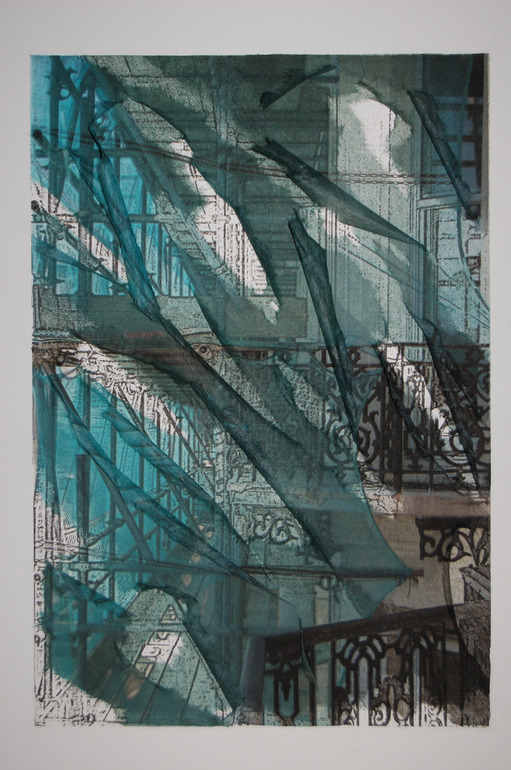
Dechirage is almost a reversal of collage, being a process of removal rather than addition. Fizz Fieldgrass creates delicate sculptures using source images such as photographs as source material, which are then printed onto fabric, built up in layers, and then torn away to create delicate three dimensional images.


example of dechirage by Fizz Fieldgrass


Fieldgrass has a background in sculpture, and his use of textiles and Japanese papers was a source of admiration for many seeing his work this weekend. The main concern by visitors was how long the work will survive, given the delicate nature of the work; a currently  unanswered question.
dechirage by Fizz Fieldgrass