Showing posts with label intimate landscapes. Show all posts

Saturday, 10 April 2021

On feathers - words and images in response to a pre-covid photograph


Picture
Dawn Flight, Camber Sands 2019


I belong to the 'photo and text' group of London Independent Photography.
A group for photographers who also enjoy words, and who value the added meaning that text can bring.

At our last meeting we agreed to respond with words and/or images to a photograph that I made on a balmy summer's morning in the pre-covid days.

Gulls at dawn, on a gentle high tide. A double exposure with a feather filling the sky.

I decided to respond with words and new photos in the form of a poem. The following words and images are my thoughts and reflections.


Dawn flight

A photograph;
gulls drifting and rising
calling and falling over
waves stilled in the windless air.
A peachy morning glow
Picture
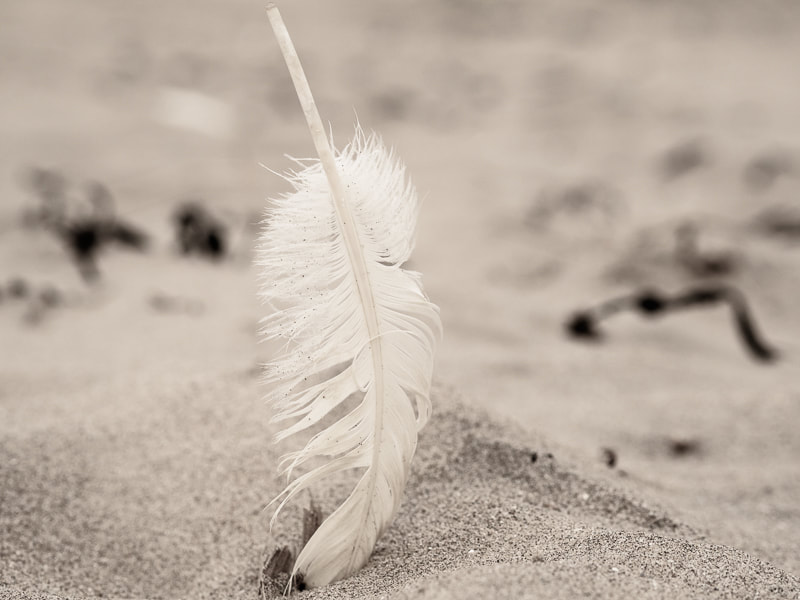
Feather | Caroline Fraser 2021


A feather....

its quill still,
(no writing today)

emerges skywards 
from its silica bed.
Battered and torn,
no longer worn.
A feather re-fresh.
Self maintenance, gull style.
The pre-breeding molt.

A delicate descent
of plumage
from sky to sand.


Does it hurt when they fall?
​Why do we never see the descent?


How many feathers are needed for a bird to fly?

‘The work of feather counting is tedious and exacting, and yields small result relative to the labour involved

In 1932 Phoebe Knappen counted 11,903 feathers on an adult female mallard.


Picture
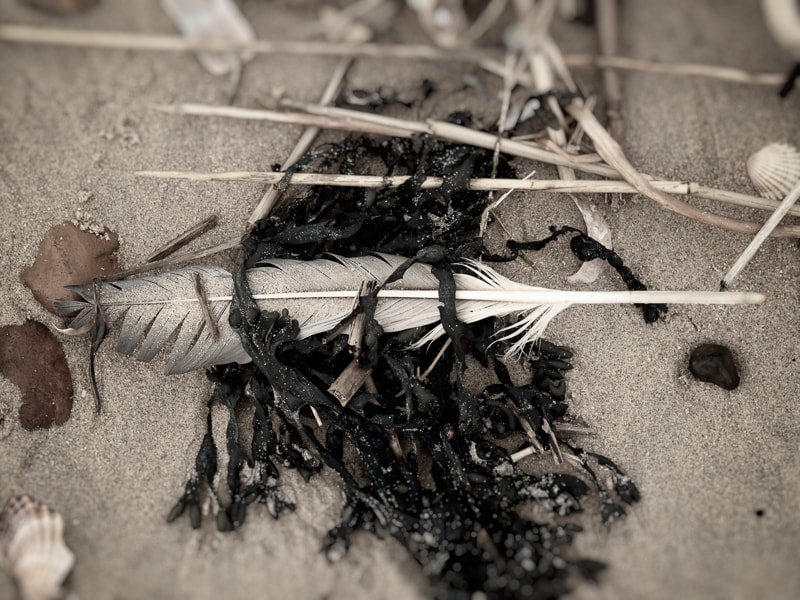
feather detail | Caroline Fraser 2021


Rachis and vane.
Calamus and barbule.
(I am learning the words all over again).
Ripped and contorted by the roll and clatter
of pebbles on a spring tide,
lying in repose amongst fragments 
tossed landwards from the deep.
The exquisite curls of downy barbs
lie abutted as if trees on a windswept hill.

Picture
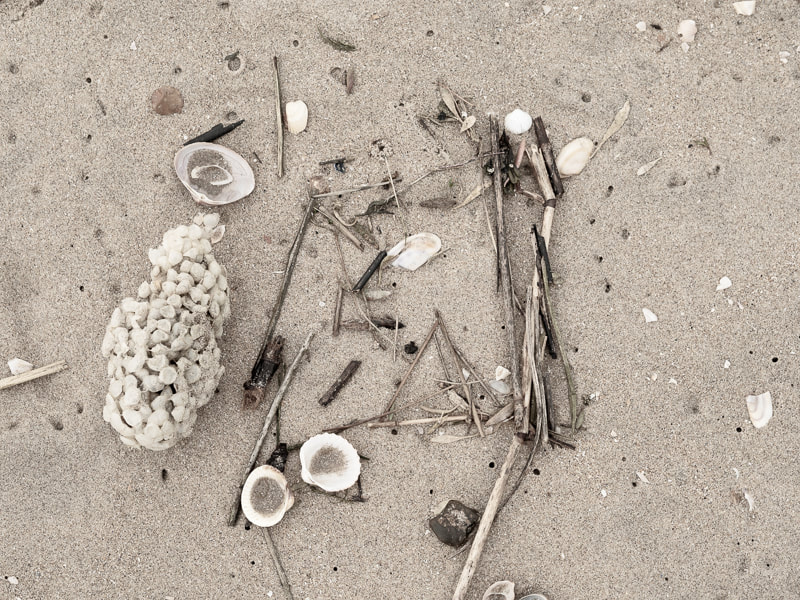
beach debris | Caroline Fraser | 2021


I counted five feathers as I strolled
with the photograph in mind
The average gull has 5000.
Where are the rest?
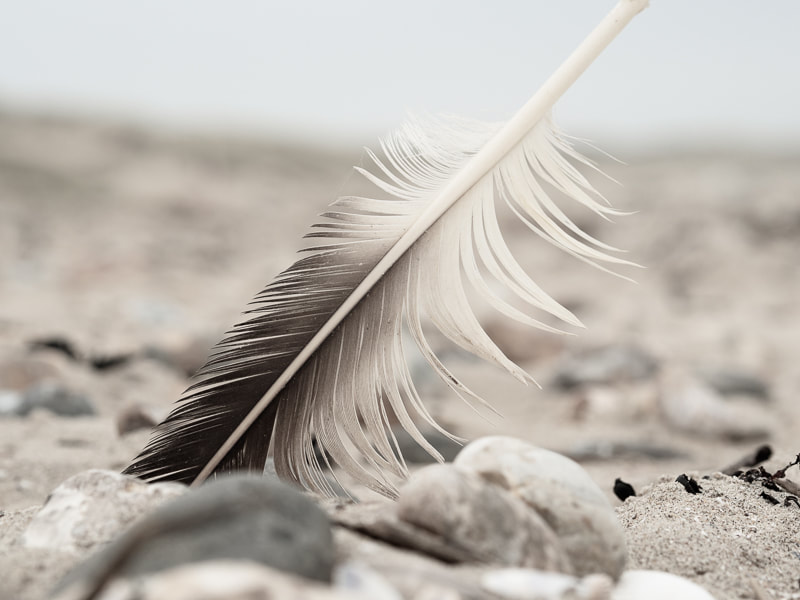
Picture
gull feather | Caroline Fraser | 2021


Thank you for reading...... it has been a while.... I think covid recovery took longer than I realised. 

I could add some comments about home life and how my other half has turned very unexpectedly into a model railway enthusiast, but you probably don't want to know the finer details of track laying and the correct angles for smooth running of railway curves.....

I insisted that he purchase a name sign for his station. I wait with bated breath; the choices are endless. It's a big decision. Suggestions welcome.

​Watch this space.....


Saturday, 30 July 2011

travelling light ..............an experiment with my Panasonic Lumix


bunchberry © caroline fraser 2011
I have just returned from Western Canada on a trip from Vancouver Island across the coastal ranges that include the Rockies, to Calgary. We were 11 in a far too small minibus, and had been advised to keep our luggage to less that 14kg, as it was to be carried on the roof of the van. I duly obeyed the instructions ( and was glad that I had, as we had to lift our luggage up high on an almost daily basis as we moved from one location to the next). Normally I travel with my Canon 40D plus several lenses, and my Panasonic Lumix for back up/hiking up mountains. On this trip I was challenged to cut back on weight, and in the style of Charlie Waite's dvd 'Travelling Light' http://www.charliewaite.com/store decided to travel light with my trusty Panasonic Lumix only; with no extra lenses, tripods, extra hard drives or external flash.

I have fallen in love with my Panasonic, and my only concern was the lack of zoom; as we were on a tour there would be no time to get a tripod out, or fiddle about with lots of lenses.

So how did it go..........?

Firstly, I have no regrets about my decision; every time we stopped the bus to get out and see something I was relieved not to have to decide what kit I needed, and in the tight space of the bus there was nowhere to put all my usual equipment without using up space for someone else's arm/leg or bottom. I kept my camera around my neck, and therefore was always ready to grab a shot.

The Lumix is brilliant for landscapes providing the light is reasonable and you don't need a tripod. I am not that interested in capturing sunsets and sunrises, so that was not a problem. When hiking, it sits around my neck, and I was able to take shots while others were worried about getting their cameras out in the rain or from their back packs when climbing up mountains. My first love is capturing the intimate landscapes below my feet, and for this it is perfect, coping best when the weather is dull or just after rain when the foliage is fresh. The one thing a landscape photographer doesn't really need is harsh sunshine, and we  had little of that. Shadows are a problem in intimate and larger landscapes;  a lesson I learnt from the talented landscape photographer Joe Cornish whilst at Inversnaid in Scotland a few years ago.

The down side of the Lumix came to light when capturing wildlife; it really isn't suitable for wildlife photography, as the following images show.

wild life photography with a Lumix
This is a wildlife image of a Pica; a small Canadian animal a bit like a guinea pig. You may be wondering where it is.........


Pica

You may also be wondering what is looks like..........


as you can see, it is kinda cute
Final verdict is that it is totally not suitable for wildlife photography, and because of that ( and the prospect of 3 hours feeling sick) I skipped the whale watching tour, and went for a wonderful walk in the rainforest instead, where I had a  chance to capture a very large slug at close range ( not very well, as it's head is out of focus and it's tail is missing). My excuse for this transgression is that I was all alone and worried I might meet a bear!